

Luke 24: 13-35, NRSVUE
13 Now on that same day two of them were going to a village called Emmaus, about seven miles from Jerusalem, 14 and talking with each other about all these things that had happened. 15 While they were talking and discussing, Jesus himself came near and went with them, 16 but their eyes were kept from recognizing him. 17 And he said to them, “What are you discussing with each other while you walk along?” They stood still, looking sad. 18 Then one of them, whose name was Cleopas, answered him, “Are you the only stranger in Jerusalem who does not know the things that have taken place there in these days?” 19 He asked them, “What things?” They replied, “The things about Jesus of Nazareth, who was a prophet mighty in deed and word before God and all the people, 20 and how our chief priests and leaders handed him over to be condemned to death and crucified him. 21 But we had hoped that he was the one to redeem Israel. Yes, and besides all this, it is now the third day since these things took place. 22 Moreover, some women of our group astounded us. They were at the tomb early this morning, 23 and when they did not find his body there they came back and told us that they had indeed seen a vision of angels who said that he was alive. 24 Some of those who were with us went to the tomb and found it just as the women had said, but they did not see him.” 25 Then he said to them, “Oh, how foolish you are and how slow of heart to believe all that the prophets have declared! 26 Was it not necessary that the Messiah[j] should suffer these things and then enter into his glory?” 27 Then beginning with Moses and all the prophets, he interpreted to them the things about himself in all the scriptures.
28 As they came near the village to which they were going, he walked ahead as if he were going on. 29 But they urged him strongly, saying, “Stay with us, because it is almost evening and the day is now nearly over.” So he went in to stay with them. 30 When he was at the table with them, he took bread, blessed and broke it, and gave it to them. 31 Then their eyes were opened, and they recognized him, and he vanished from their sight. 32 They said to each other, “Were not our hearts burning within us while he was talking to us on the road, while he was opening the scriptures to us?” 33 That same hour they got up and returned to Jerusalem, and they found the eleven and their companions gathered together. 34 They were saying, “The Lord has risen indeed, and he has appeared to Simon!” 35 Then they told what had happened on the road and how he had been made known to them in the breaking of the bread.
I started this summer by traveling to Burgundy, France with Princeton Presbys.1 Our little group of nine joined thousands of others spending the week as pilgrims at Taizé, an ecumenical monastic community founded in the 1940s on a mission of cooperation, dialogue, and peace. Something like 100,000 people, especially young adults between 18-35, make the trip each year to live in community with the brothers, meet people from all over the world, and worship together in the Taizé style.2
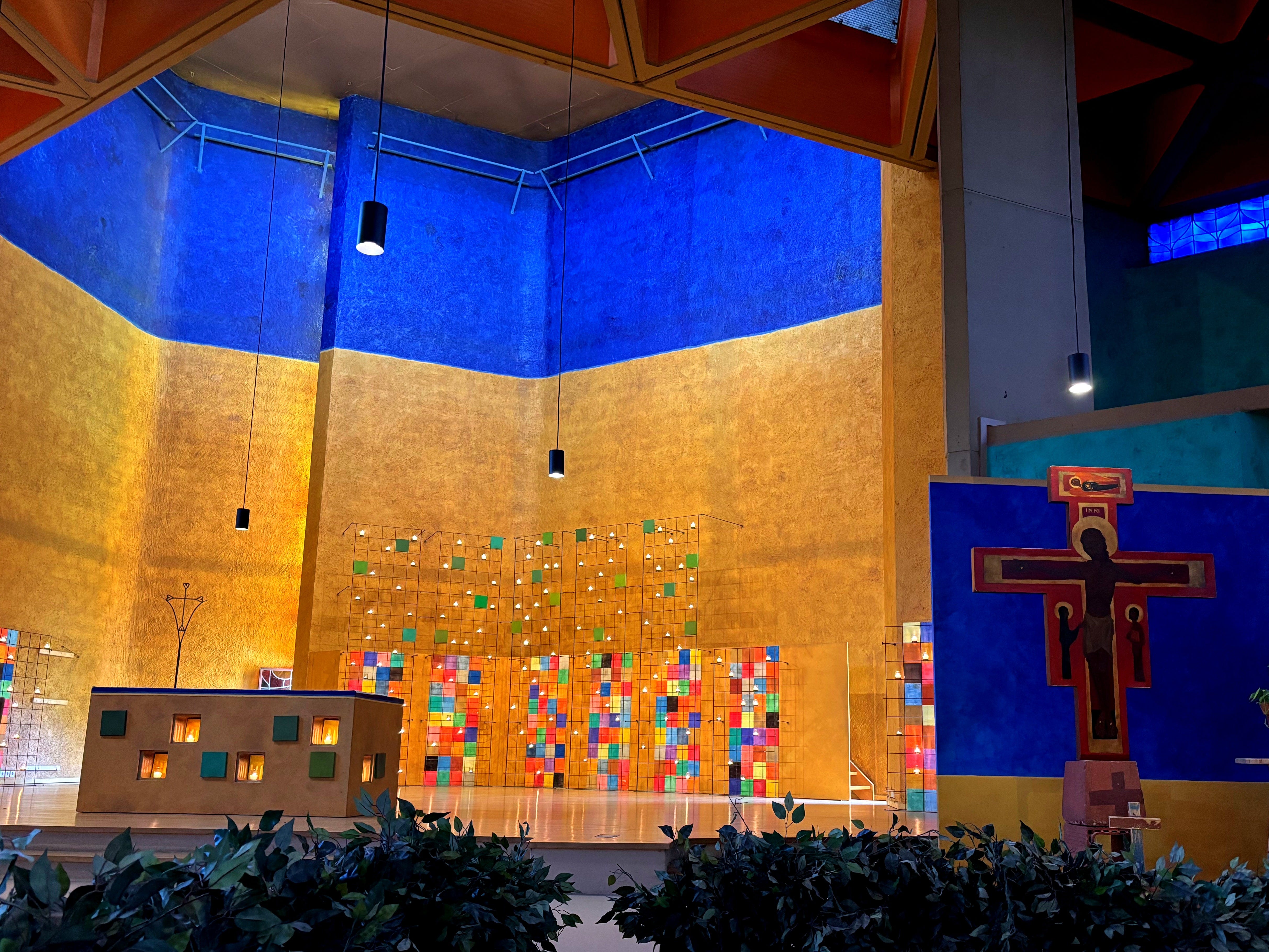


There’s a lot I could say about the trip. Not all of that is positive (utopias don’t exist, and the simplicities of Taizé come with as many challenges as they do gifts), but mostly I really, really loved my time there. If anything, I surprised myself with how much I loved it—the simple rhythms of the day and the beauty of everything around us and the balance of music and silence. I’m so grateful that, through Presbys, I found out about Taizé and that I got the chance to experience it. And I hope very much to get to return one day.
All that said, somehow and somewhat ironically—the most meaningful thing I did that week was stop taking communion.
Let me try to explain.
The obvious starting point for communion stories is the gospel accounts of the Last Supper. There’s plenty to say there, and there’s a reason we tell part of that story in communion liturgy. But I’m going to start instead with an Easter meal, with a story of bread shared not in anticipation of betrayal, but in celebration of resurrection. In this passage from Luke, two travelers walking from Jerusalem to Emmaus encounter Jesus.
What I really want to pay attention to is what happens before and after verse 29, when we learn that:
“[The travelers] urged [Jesus] strongly, saying, “Stay with us, because it is almost evening and the day is now nearly over.”
Let’s start with what happens before: The story begins with our two strangers talking to each other about the empty tomb and the dead prophet. When Jesus appears to them, they don’t recognize him. In fact, they tell Jesus about this crazy story they’ve heard from Jerusalem: about this prophet that they had hoped would changed the world, but who’d been killed and buried, and the strange empty tomb, and how the women were claiming that they heard angels say he was alive. We’re told that Jesus then says that this is his story and that he explains, but there is nothing in the text about that message being believed, no indication that the strangers are convinced that this is anything more than a tall tale. Instead, in verse 28, the travelers and Jesus arrive in Emmaus, and Luke tells us that Jesus seems like he is going to continue on his journey alone.
Until, that is, in verse 29, the travelers urge him to stay. It’s late. It’s getting dark. Stay to dinner. Jesus accepts. Verse 29 ends:
“So he went in to stay with them.”
In the original Greek, it’s intimated that Jesus would have continued on had the travelers not spoken. The NRSVUE translation draws out this counterfactual even more explicitly, the “so” in verse 29 showing that Jesus stays as a result of being invited in.
Picking out one cause amongst many reasonable candidate causes is what psychologists and philosophers call the causal selection problem.3 It comes about because there are always infinite candidate causes: The spark and the dry wood caused the fire, but so did the oxygen in the air. Texting caused the car accident, but so did the presence of the other car and the exact time of leaving the house. So-and-so started the fight, but they wouldn’t have been there if they hadn’t been born, if their parents hadn’t met, if their grandparents on their mother’s side hadn’t immigrated, and so on and so on.
We don’t usually think about the causal selection problem because picking out one cause over another is often so intuitive it’s automatic. It feels obvious, for instance, to say that the spark, and not the oxygen, started the fire. But the fact that our choice of causes can be unconscious doesn’t change the significance of the choice or what it communicates. Picking out one particular cause amongst many candidates calls attention to the difference made by that particular event, and our attention matters.4
And what Luke picks out as a difference-maker is that Jesus would have continued on, but didn’t, because the travelers invited him to stay.
Then after verse 29, when they sit to table together, Jesus blesses the bread, offers it back to his hosts, and opens their eyes. Now, they recognize him. This is because of Jesus’ invitation in breaking and offering the bread—but also, and I think more importantly, because of their invitation to him to join their table. That’s the difference-maker that Luke calls attention to, the only time we are explicitly told that something else would have happened if this event had not occurred.
Jesus is a stranger to these travelers. A stranger they don’t believe! It’s not that their eyes are opened first, and because of their belief in the risen Lord they want to offer him a place in their home. It’s that they invite in a stranger on the road because it is getting dark and it is time for dinner and that is all reason enough.5
Everything else happens afterwards.
everything else happens afterwards.
When we get it right, I think communion is everything I want to take from Christianity into how I walk through the world. Not because I think it’s mystical or literally transformative (in any of the ways you want to apply ‘literal’ and/or ‘transformative’) but because of the kind of genuinely no-conditions welcome that is maybe impossible and yet what we ought to aspire to.
In other words, I think the Walk to Emmaus is an argument in favor of open communion.
Truly, radically, open communion.
Long before making the trip to Taizé, I kept coming back to Princeton Presbys. The student ministry celebrates communion each week in a service fittingly named Breaking Bread that also ends with us eating dinner together. These days, when I think about breaking bread, I can’t help but think about Breaking Bread.
Len and Andrew Scales, who pastor to this community, actually bake the bread themselves each week. They invite people to come forward, rip off a big piece of bread (“because God’s grace is bigger than this entire loaf!”) and take communion by intinction (“which is just a fancy word for dipping!”).6 The bread is gluten-free and vegan, and the cup is grape juice only so that “as many people as possible can partake.” Everyone is explicitly welcomed to receive communion. And the first week I heard Andrew say, “These are the gifts of God. They are for you, the people of God” was maybe the first time I really felt like a pastor truly believed that everyone was a child of God.
When I think about all that I love about church, all that I think can be done right in the name of Christ—the image that will always, always come to mind for me is the simplicity and the beauty of Len and Andrew then taking it in turns to offer communion to each other. With bread they had literally shaped with their own hands, and with just as much sincerity in their words and faces as they had when they invited each of us—by name—to God’s table—partners in life and ministry offered each other the gifts of communion.
By most metrics, Taizé celebrates communion in an incredibly open and welcoming way. Taizé is one of the few places in the world where Catholic, Orthodox, and Protestant Christians receive communion together. That’s amazing. I don’t want to take away from that.
But there is still a condition you have to meet in order to be offered communion: Those who are baptized are invited to take the consecrated elements. If not, volunteers also offer blessed bread, which Taizé notes is their way of honoring Jesus’ feeding and welcoming of all. But what I couldn’t get over was how this still felt like a kind of segregation, still a kind of “you are welcome, if…”
I love communion with Breaking Bread. It’s no small part of why I kept coming back each Sunday night. But on the first morning at Taizé, I took communion and it left a metaphorically sour taste in my mouth. I didn’t feel like I was being welcomed to God’s table in remembrance of something radical and beautiful. I felt like I was participating in a kind of us-and-them in-grouping that still makes me deeply wary of organized religion and of Christianity in particular.
Maybe that’s a harsh assessment when everyone baptized was invited to partake together. Maybe being a professing Christian seems like a low and even obvious prerequisite to participating in Christian ritual.
But the men on the way to Emmaus? They didn’t believe first. They weren’t convinced yet; their eyes were still closed. The thing that happens first, that means Jesus stays and everything else has a chance to unfold, is just that they are willing to invite a stranger to their table. That’s what Luke calls attention to; that’s what makes all the difference.
No faith required but in the inherent value of welcome.
So for my week visiting Taizé, in the most spiritual setting I’ve ever found myself in, I stopped taking communion. Not because I, personally, felt excluded from the practice, but because it wasn’t the practice I recognize as communion if it came with a condition to entry. And invited or not, I didn’t want to participate.
Or, maybe, I should say—I stopped taking communion when it was formally offered by the brothers in the morning service.
Because there were nights when our little group cobbled together what Len joked was “chaos girl dinner” from farmer’s market and local farm trip purchases, offering up whatever we had: bread, yogurt, berries, cheese, an unwashed head of lettuce. Sharing a meal in every sense of the word—the way that friend, can also be companion (copain in the French), can literally mean those with whom you take bread.7 Just offering what we could, whatever we had, to each other.
Then Andrew looked around at all of us, laughing and chattering and enjoying our motley shared meal, and said: “I think this is what Jesus would have wanted.” A little cheesy (sorry, Andrew!), but not wrong.
So maybe our job when offering communion, both formally and informally, is as much to try to live up to the example of those who offered communion to Jesus as much as it is to live up to the example of communion offered by Jesus. For the strangers at Emmaus, and maybe for us at Taizé, that ends up coming to much of the same thing.
We can say: Come, take, eat. These gifts, they are for you. Yes, you.
Full stop.
And everything else, whatever that may be, can only happen after.
Princeton Presbyterians is the ministry of Westminster Foundation, serving undergraduate and graduate students in the Princeton area (mostly from Princeton University and Princeton Theological Seminary). They describe themselves as “by Presbyterians, for everyone.”
Taizé worship features simple songs, with one or two lines sung over and over in a kind of meditation. The Taizé songbook includes music in languages from all over the world, and at Taizé itself, the songs are chosen each week to reflect the languages of the people visiting. My first introduction to Taizé were services sung in the Taizé style.
See, e.g.,
Hesslow, Germund. "The problem of causal selection." Contemporary science and natural explanation: Commonsense conceptions of causality (1988): 11-32.
Quillien, Tadeg, and Christopher G. Lucas. "Counterfactuals and the logic of causal selection." Psychological Review 131.5 (2024): 1208.
It matters so much in all sorts of interesting ways that I couldn’t get into here, but for example: Picking one event over another when both needed to happen (i.e., there are two pens on the desk and Susie takes one and Emily takes one and now the office is out of pens) can imply that one event was against the rules and the other wasn’t and/or that one was statistically likely and the other wasn’t. Attributing personal instead of structural causes demonstrates essentialist biases for a range of social phenomena, even in young children. And (including in some of my own work!) an actual person is usually only an acceptable cause if they acted intentionally of their own free will.
An extremely abridged list of references demonstrating the above effects:
Halpern, Joseph Y., and Christopher Hitchcock. "Graded causation and defaults." The British Journal for the Philosophy of Science 66.2 (2015): 413-457.
Kirfel, Lara, Thomas Icard, and Tobias Gerstenberg. "Inference from explanation." Journal of Experimental Psychology: General 151.7 (2022): 1481.
Lombrozo, Tania. "Causal–explanatory pluralism: How intentions, functions, and mechanisms influence causal ascriptions." Cognitive psychology 61.4 (2010): 303-332.
Peretz-Lange, Rebecca, Jennifer Perry, and Paul Muentener. "Developmental shifts toward structural explanations and interventions for social status disparities." Cognitive Development 58 (2021): 101042.
In a moment where The Odyssey is at the center of the zeitgeist, it’s worth noting that this welcome that the strangers show Jesus also goes beyond the classical hospitality laws of xenia, or Zeus’s law. If you’ve seen Nolan’s Odyssey, you’ve heard Tom Holland say that another character has “Athena’s eyes” maybe half a dozen times. In the ancient world, or at least in this version of it, you treat strangers and beggars well because anyone might actually be a god in disguise. But the walk to Emmaus, the travelers don’t think there’s a possibility that Jesus might be the prophet of the scriptures. Their eyes aren’t opened until after they eat the bread, after Jesus blesses it, after they invite Jesus to share in it with them. In the moment they invite him to stay, in the moment that makes all the difference, he is just a stranger on the road.
Sorry, an inside joke! Lines that Len and Andrew say so often they’ve become part of the ‘script’ of Breaking Bread and are funny, goofy bits as much as anything else. Honestly, I love little moments like this.
Companion comes from the latin companionem, from com “with, together” and panis “bread.” And, fittingly for this story, probably replaced the old Englsih word gefera, meaning “traveling companion.”
“Companion.” Online Etymology Dictionary, etymonline.com. Accessed 27 August 2026.
"But the men on the way to Emmaus? They didn’t believe first. They weren’t convinced yet; their eyes were still closed. The thing that happens first, that means Jesus stays and everything else has a chance to unfold, is just that they are willing to invite a stranger to their table. That’s what Luke calls attention to; that’s what makes all the difference. No faith required but in the inherent value of welcome"
I am also of course an open communion girlie and have been but your exegesis of this story is another very strong argument as to why we should be!